Performance Assessment · For Executives, Professionals & Athletes

Become the athlete your sport needs.

Where your sport lives on the force-velocity continuum. What training actually moves the needle. And how to tell the difference.

Recent case

16-year-old semi-pro soccer player. From knee pain to an 85 kg front squat for reps, pain-free, in six months.

The Framework

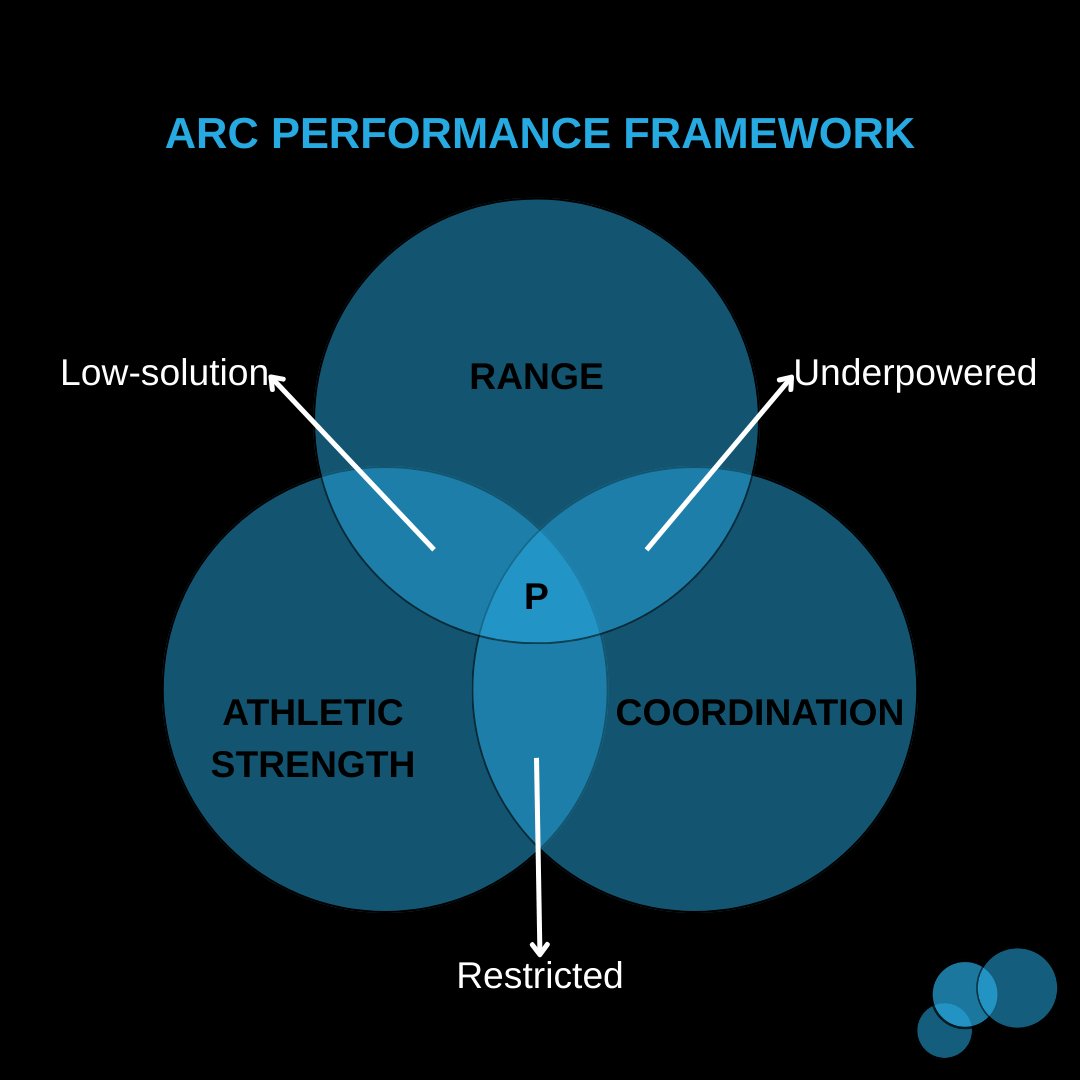
Performance does not come from one quality. It emerges when athletic strength, range, and coordination coexist. Most athletes are missing qualities. Find and train the missing piece.

ARC Performance Framework Venn diagram

A

Athletic Strength

Be strong, fast, explosive, powerful, adaptable.

Without it: underpowered athlete

R

Range

Own positions with adequate mobility and stability.

Without it: restricted athlete

C

Coordination

Have multiple movement solutions ready to solve the problems sport throws at you.

Without it: low-solution athlete

Force, Velocity, Time

Every athletic task is a time-constrained force problem. The faster the movement, the less time to apply force, and the different the strategy your body needs. The curve below maps where each sport lives.

The Force-Velocity Continuum with four regions: Strength, Strength-Speed, Speed-Strength, Speed

The Assessment

Where does your sport live?

Answer all four questions based on what happens in competition, not in the gym. The region that appears most often is your primary.

Question 01

What does a critical moment in your sport demand?

  1. A

    Hold, drive, or control. Sustained force against resistance, with time to produce it.

    Strength
  2. B

    Accelerate or explode in one direction. A powerful burst into a defined direction, brief but prepared.

    Strength-Speed
  3. C

    React and redirect. A quick cut or lateral adjustment where the outcome is not known until the last moment.

    Speed-Strength
  4. D

    Sustain maximum speed. Reach and maintain top velocity over distance or repeated fast actions.

    Speed

Question 02

Does your sport have different demands depending on position or phase of play?

  1. A

    No. Every role and phase demands the same quality: maximum force.

    Strength
  2. B

    Some variation, but explosive force is constant across all roles and phases.

    Strength-Speed
  3. C

    High variation. Different positions or phases live in meaningfully different regions.

    Speed-Strength
  4. D

    Minimal. Everyone has the same job regardless of role: move as fast as possible.

    Speed

Question 03

What does fatigue look like in your sport?

  1. A

    You cannot produce as much force. Positions become harder to hold, and driving through contact weakens.

    Strength
  2. B

    Explosiveness goes first. First steps slow down, jumps lose height, throws lose pop.

    Strength-Speed
  3. C

    Reactions and sharpness deteriorate. A half-step slow to react, cuts get rounded, transitions lose crispness.

    Speed-Strength
  4. D

    Top speed drops and mechanics break down. Stride shortens, contacts get heavier, coordination deteriorates.

    Speed

Question 04

What does recovery between efforts look like?

  1. A

    Long rest between high-force efforts. Sets, rounds, or bouts with clear rest. The demand is high force, not high frequency.

    Strength
  2. B

    Repeated explosive efforts with structured breaks. Partial recovery, predictable enough to prepare for the next.

    Strength-Speed
  3. C

    Continuous with unpredictable high-demand moments. Always moving, must be ready to react.

    Speed-Strength
  4. D

    Full recovery between maximal speed efforts. The quality of each run matters more than density.

    Speed

The region that appears most often is your primary. The adjacent region matters too, but the primary sets the training emphasis.

Free Guide

Get the complete assessment on paper.

What's Next

You know where your sport lives. Now find out where you stand.

Knowing the target is step one. Mapping your current qualities against it is the next layer. That's what I do with every athletic client: we turn this framework into a training plan built around your gap, not a generic template.
